AI virtual agents are rapidly transforming how businesses communicate with customers, employees, and partners. By leveraging AI for customer service agents, organizations are not only streamlining interactions but also boosting agent productivity, allowing teams to focus on higher-value tasks and more complex problem-solving. Far beyond basic chatbots, modern virtual agents can understand natural language, offer personalized solutions, and manage requests efficiently at any time. This leads to smoother customer experiences, more satisfied employees, and business operations that scale easily without friction.
As businesses adopt more sophisticated AI solutions, AI virtual agents are now becoming a central part of cloud-based infrastructure and advanced computer technology systems. By integrating with cloud computing platforms, enterprise-grade data storage, and intelligent automation tools, these agents can manage a wide range of tasks—from tracking customer interactions to analyzing operational performance—without disrupting existing workflows. In finance, they can assist with predictive analytics, fraud detection, and automated reporting, helping teams make faster and more informed decisions. In digital marketing and marketing automation, AI virtual agents support personalized customer campaigns, optimize content strategies, analyze engagement metrics, and provide insights that improve return on investment.
By connecting AI virtual agents to cloud-powered platforms, enterprise computer networks, and AI-driven business tools, companies can unify customer service, marketing efforts, and financial operations into one seamless system. This integrated approach ensures real-time access to critical information, more intelligent decision-making, and better collaboration across departments. The result is not only a more productive workforce but also a smarter, more responsive business that leverages cutting-edge technology to enhance customer satisfaction, drive innovation, and maintain a competitive edge in today’s fast-moving digital world.
Top AI Virtual Agent Solutions for Modern Contact Centers
AI virtual agents are transforming how contact centers operate, making customer interactions faster, smarter, and more efficient. Companies looking to improve service quality, agent productivity, and customer satisfaction can leverage these leading AI-powered platforms to stay competitive. Here are the top solutions in the market:
1. Bright Pattern – Advanced AI Contact Center Platform
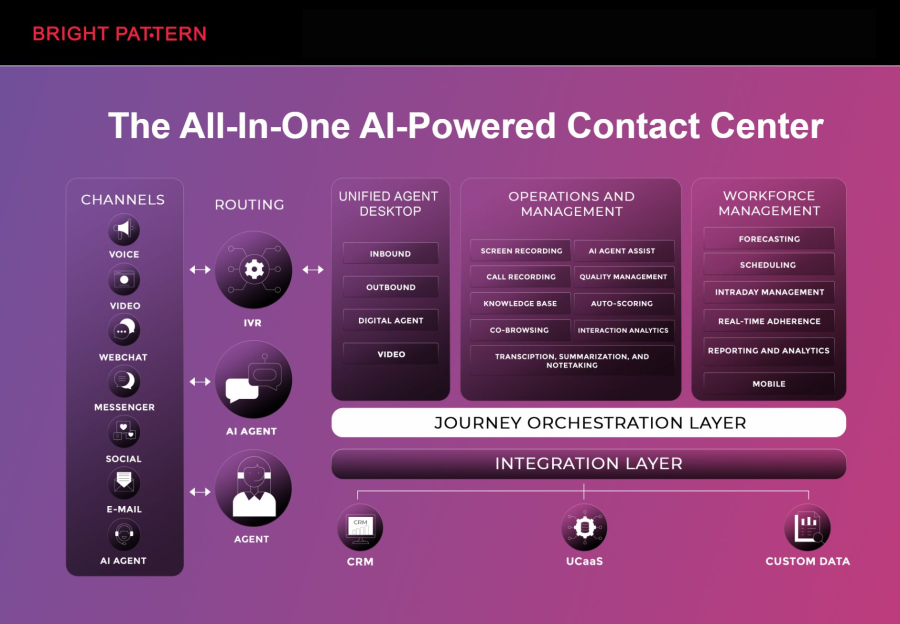
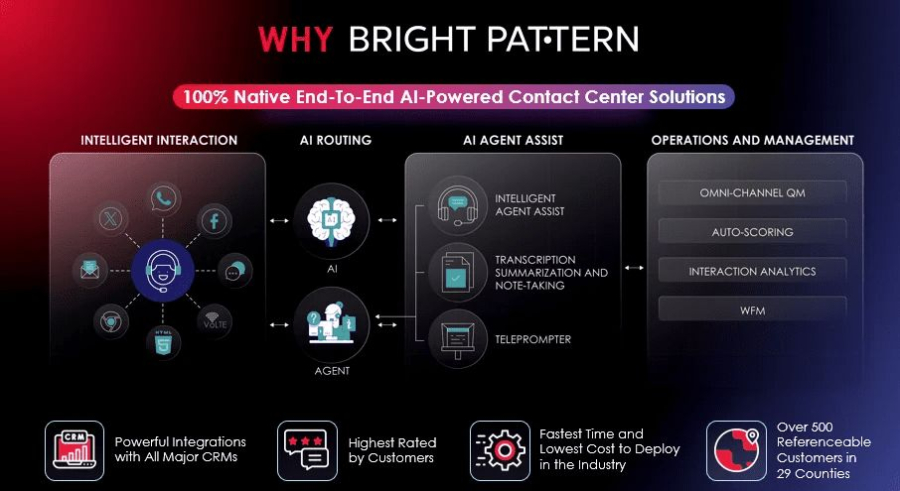
Bright Pattern stands out as a leading provider of AI virtual agents and omnichannel contact center solutions. Its platform is designed to streamline customer interactions while boosting agent productivity. Bright Pattern integrates advanced AI features that understand natural language, personalize conversations, and automate repetitive tasks, ensuring a smoother customer journey.
Key Features:
- AI-driven virtual agents for 24/7 customer support
- Intelligent routing to the right agents based on skills and availability
- Cloud-based contact center infrastructure for scalability
- Analytics and reporting tools to improve agent performance
- Seamless integration with CRM, marketing automation, and financial systems
Bright Pattern’s AI virtual agents are ideal for businesses seeking to unify customer service, digital marketing engagement, and operational insights within a single, intelligent platform.
2. Genesys Cloud CX
A comprehensive cloud-based contact center solution that leverages AI virtual agents to optimize agent productivity and automate customer interactions across multiple channels.
3. Five9 Intelligent Cloud Contact Center
Provides AI-powered virtual agents that assist with call routing, customer self-service, and predictive engagement to improve efficiency and customer satisfaction.
4. NICE CXone
An AI-driven contact center platform that combines workforce optimization, analytics, and virtual agents to enhance both agent and customer experiences.
5. Cisco Webex Contact Center
Uses AI virtual agents to support omnichannel customer service, enabling smarter routing, automated responses, and seamless integration with enterprise technology.
6. Avaya OneCloud CCaaS
Offers AI virtual agent solutions designed for multichannel contact centers, including voice, chat, and social media support with advanced analytics.
7. Talkdesk CX Cloud
Features AI-powered virtual agents that handle routine inquiries, provide insights for marketing campaigns, and help agents focus on higher-value interactions.
8. RingCentral Contact Center
Integrates AI virtual agents to automate customer service workflows, enhance agent productivity, and support cloud-based contact center operations.
9. Salesforce Service Cloud
Combines AI virtual agents with CRM-driven insights to deliver personalized customer experiences and improve efficiency in service and marketing operations.
10. Zendesk AI
Offers AI-powered virtual agents for ticketing, self-service, and engagement across multiple digital channels, helping businesses optimize support operations.
What Are AI Virtual Agents?
AnAI virtual agentis an intelligent software system that uses technologies like natural language processing (NLP), machine learning, and automation to interact with people in real time. Users can communicate with these agents through voice, chat, or messaging channels, just as they would with a human representative.
Unlike traditional rule-based bots that rely on rigid scripts, modern AI virtual agents can:
- Understand user intent, not just specific keywords
- Hold multi-step conversations and remember context
- Access business systems to complete real actions, not just provide answers
- Learn from interactions to continuously improve over time
In essence, they act as digital team members that never sleep, never queue, and can handle thousands of simultaneous conversations with consistent quality.
Why AI Virtual Agents Matter Now
Customer and employee expectations have changed dramatically. People want instant, convenient, and personalized support on the channels they already use. Long waits, limited business hours, and repetitive questions drain both customers and human support teams.
AI virtual agents directly address these challenges by providing:
- 24/7 availabilityacross time zones and geographies
- Instant responsesto common and complex questions alike
- Consistent experiencesthat reflect your brand and policies
- Scalable supportwithout needing to scale headcount at the same pace
As a result, organizations using AI virtual agents see measurable gains in satisfaction, efficiency, and revenue.
Key Benefits of AI Virtual Agents
1. Always-On Service Without Extra Headcount
One of the biggest advantages of AI virtual agents is their ability to providecontinuous, uninterrupted service. They can support customers, prospects, and employees at any time of day, including weekends and holidays, without requiring night shifts or overtime.
This creates a powerful combination:
- Customers receive help when they want it, not when your office is open.
- Your team can operate with stable, predictable staffing costs.
- Global businesses can cover multiple regions with a single, centralized solution.
2. Faster Response Times and Happier Customers
Waiting in a queue is one of the most frustrating parts of traditional support. AI virtual agents eliminate this friction by providinginstant responses. Even when a human handoff is needed, the agent can gather key information in advance so the customer spends less time repeating themselves.
The result is a smoother journey across every touchpoint:
- Website visitors get quick answers that keep them moving toward purchase.
- Existing customers resolve issues faster, boosting loyalty and retention.
- Employees receive internal support on-demand, helping them stay productive.
3. Lower Operational Costs With Higher Quality
AI virtual agents automate high-volume, repetitive tasks that typically consume a large share of support resources. By handling these interactions, they free human agents to focus on complex or high-value conversations.
This leads to a high-impact cost and quality combination:
- Reduced cost per contactthrough automation of routine queries.
- Improved first-contact resolutionas virtual agents access accurate, up-to-date information.
- More time for human agentsto build relationships and handle nuanced situations.
4. Consistent, Brand-Aligned Interactions
Human performance can vary across shifts, locations, and experience levels. AI virtual agents, by contrast, deliverconsistent, policy-aligned responsesevery time. They can be trained to use your brand voice, follow your workflows, and provide answers that reflect your standards.
As your policies evolve, you update the virtual agent once, and the new guidance is instantly reflected across all interactions. This makes it significantly easier to ensure compliance and brand integrity at scale.
5. Actionable Insights From Every Conversation
Every interaction with an AI virtual agent creates data. Over time, this data becomes a powerful source of insight, revealing what your customers ask, where they struggle, and what they really need.
With this intelligence, you can:
- Identify frequently asked questions and build better self-service content.
- Spot recurring product or service issues early and address them proactively.
- Refine your agent scripts and training to match real user behavior.
This closed feedback loop turns your virtual agent into an engine for continuous improvement across your entire customer experience.
How AI Virtual Agents Work: Core Capabilities
Natural Language Understanding
Modern virtual agents usenatural language understandingto interpret what users say or type. Instead of relying on exact keyword matches, they focus onintent— the underlying goal behind the message.
For example, customers might phrase the same need in multiple ways:
- “Where is my order?”
- “Track package”
- “I never got my delivery”
An AI virtual agent can recognize that all these messages point to adelivery statusintent and respond accordingly.
Context Management and Memory
Advanced agents remember details shared earlier in the conversation, such as a user’s name, previous answer, or stated preference. Thiscontext managementenables more natural, human-like interactions.
Instead of making users repeat information, the agent can build on what it already knows:
- Confirming identity once, then referring back to it correctly.
- Recognizing returning users and tailoring responses based on past interactions.
- Keeping multi-step workflows on track, even if the user changes direction mid-conversation.
Integration With Business Systems
The most valuable virtual agents do more than just answer questions. Theyconnect to your systemsto perform actions on behalf of the user. Depending on your setup, an AI virtual agent can:
- Look up account details in your CRM or billing platform.
- Submit or update support tickets.
- Schedule, reschedule, or cancel appointments.
- Guide users through order changes, returns, or upgrades.
These capabilities turn the virtual agent into a powerful digital front door that not only informs but alsogets things done.
Continuous Learning and Optimization
AI virtual agents can improve over time through a combination of automated learning and human-guided tuning. As more users interact with the agent, patterns emerge: which responses land well, which paths lead to successful outcomes, and where users tend to drop off or ask for human help.
By reviewing this data and adjusting flows, training phrases, or knowledge content, you can steadily increase resolution rates and satisfaction scores. The more your virtual agent is used, the more valuable it becomes.
Top Use Cases for AI Virtual Agents
Customer Support and Service
Customer service is one of the most common and impactful areas for virtual agents. Typical scenarios include:
- Answering product or policy questions.
- Helping with order status, shipping, and returns.
- Troubleshooting simple technical issues.
- Routing complex cases to the right human team.
By handling a high percentage of routine requests, AI virtual agents reduce wait times while allowing human agents to focus on advanced or emotionally sensitive situations.
Sales and Lead Generation
Virtual agents can also act as proactive sales assistants. When website visitors arrive, an AI agent can engage them, understand their context, and guide them to relevant products or services.
Common sales-focused capabilities include:
- Qualifying leads by asking targeted questions.
- Recommending products based on user needs or browsing behavior.
- Booking demos or consultations for sales teams.
- Following up with visitors who showed interest but did not convert.
This makes your digital channels work harder for you, capturing opportunities that might otherwise slip away.
Employee Self-Service
AI virtual agents are equally powerful inside your organization. Many companies use them forinternal support, helping employees get quick answers to HR, IT, or operations questions.
Examples include:
- HR inquiries about benefits, leave, or company policies.
- IT support for password resets, access requests, or software guidance.
- Operations questions about procedures, documentation, or approvals.
By giving employees instant access to the information they need, virtual agents shorten resolution times and reduce the load on internal support desks.
Onboarding and Training
New customers and new employees both benefit from guided onboarding experiences. AI virtual agents can act asinteractive coaches, offering step-by-step assistance and answering questions in the moment.
They can:
- Walk users through product setup or initial configuration.
- Introduce features gradually to avoid overwhelming new users.
- Provide quick access to tutorials, guides, or knowledge articles.
This leads to faster time-to-value for customers and more confident, productive new hires.
Where AI Virtual Agents Fit in Your Omnichannel Strategy
Customers expect seamless experiences across websites, mobile apps, messaging platforms, and voice channels. AI virtual agents are a natural fit for anomnichannel strategybecause they can operate across multiple touchpoints with a shared brain.
For example, your virtual agent can be available on:
- Your website as a chat widget.
- Your mobile app as an in-app assistant.
- Messaging channels such as SMS or chat applications.
- Voice channels such as phone systems or smart speakers.
With a unified design, users receive consistent answers and can start a conversation on one channel and continue it on another without losing context. This level of continuity is a powerful differentiator in crowded markets.
Designing a Successful AI Virtual Agent
Start With Clear Objectives
Strong virtual agents are built around specific, measurable goals. Before you start, define what success looks like. Common objectives include:
- Reducing average handling time for support interactions.
- Increasing self-service resolution rates.
- Boosting lead capture or conversion on key pages.
- Improving satisfaction scores across key customer journeys.
Clear goals guide your design decisions and help you prioritize features that deliver the most value.
Identify High-Value Use Cases
Next, determine which types of interactions your virtual agent should handle first. Focus onhigh-volume, repeatable, and well-defined tasks, such as:
- Frequently asked questions.
- Status checks (orders, tickets, appointments).
- Simple updates (contact information, preferences).
- Guided workflows with clear steps.
Starting with these use cases lets you quickly show impact while building a strong foundation for more advanced capabilities.
Craft a Clear, Human Voice
Even though your virtual agent is powered by AI, the experience should feel human, friendly, and aligned with your brand. Define atone of voicethat reflects your identity — whether that is professional and calm, energetic and playful, or somewhere in between.
Pay attention to:
- How the agent greets users and introduces itself.
- The level of formality in responses.
- How it handles confusion or missing information.
- How it transitions to human support when needed.
Plan for Smooth Human Handoffs
AI virtual agents and human agents are most powerful when they work together. A well-designed experience includesgraceful escalation pathsfor scenarios that require human judgment or empathy.
Your design can include:
- Clear triggers for routing certain topics to human teams.
- Options for users to request a human at any time.
- Passing conversation transcripts and context so humans pick up where the agent left off.
This partnership model reassures users that help is always available and gives your team a strong safety net while the virtual agent scales.
Measuring the Impact of AI Virtual Agents
To maximize results, treat your virtual agent as a living product, not a one-time project. Monitoring key metrics and adjusting over time keeps performance moving in the right direction.
Key Performance Indicators (KPIs)
Common KPIs for AI virtual agents include:
- Containment rate: the percentage of interactions fully handled by the virtual agent without human help.
- Resolution rate: the percentage of interactions that reach a successful outcome.
- Customer satisfaction scoresfor conversations involving the virtual agent.
- Average handling timeacross blended (virtual plus human) workflows.
- Volume deflection: number of contacts shifted from phone or email to automated channels.
Qualitative Feedback
Beyond numbers, qualitative input from users and agents is invaluable. Look for:
- Comments from customers about the clarity and helpfulness of answers.
- Feedback from support agents on the quality of handoffs.
- Insights from managers on how the virtual agent affects team workload.
Combining quantitative and qualitative data helps you fine-tune your agent for real-world impact.
AI Virtual Agents by Industry
Every sector can benefit from AI virtual agents, but the most common patterns vary by industry.
Industry | Typical Use Cases | Primary Benefits |
Retail and eCommerce | Order tracking, returns, product recommendations, store information | Higher conversion, fewer abandoned carts, efficient post-purchase support |
Banking and Financial Services | Balance inquiries, transaction details, card support, FAQs | Improved accessibility, reduced call volume, consistent compliance messaging |
Telecommunications | Billing questions, plan changes, technical troubleshooting, outage information | Shorter wait times, scalable support during peak events, reduced churn |
Healthcare | Appointment scheduling, pre-visit questions, basic information, reminders | Better patient engagement, fewer no-shows, more efficient scheduling |
Travel and Hospitality | Booking support, itinerary updates, check-in help, local information | Smoother journeys, increased upsell opportunities, 24/7 traveler support |
Education | Admissions questions, course information, student support, campus services | Improved student experience, reduced admin workload, global reach |
Practical Tips for Launching Your First AI Virtual Agent
1. Start Focused, Then Expand
Instead of trying to automate every possible interaction from day one, choose anarrow but high-impact scope. Launch with a clearly defined set of topics or workflows, monitor performance closely, and expand gradually as you gain confidence and insights.
2. Use Real Conversation Data
When designing intents, flows, and responses, draw on real transcripts, emails, and tickets. This ensures that your agent speaks in the language your customers actually use and addresses the scenarios that show up most frequently.
3. Involve Your Frontline Teams
Support and sales teams have a deep understanding of customer questions and expectations. Involving them in the design and iteration process makes your virtual agent more accurate, more empathetic, and more aligned with day-to-day realities.
4. Make It Easy to Improve Over Time
Set up a regular review rhythm to examine conversations, identify opportunities, and fine-tune your experience. Even small adjustments — like clarifying a question or adding a follow-up prompt — can significantly boost resolution and satisfaction.
The Future of AI Virtual Agents
The capabilities of AI virtual agents are expanding rapidly. Advancements in language models, voice technologies, and automation are unlocking new possibilities, such as:
- More natural, conversational interactions that feel increasingly human.
- Richer personalization based on history, preferences, and behavior.
- Deeper integration into end-to-end workflows, from discovery through loyalty.
Organizations that embrace virtual agents now are not just solving today’s support and engagement challenges. They are laying the foundation for a future where intelligent digital teammates are embedded across every part of the customer and employee journey.
Bringing It All Together
AI virtual agents combine always-on availability, fast responses, and powerful automation to deliver better experiences at scale. By taking a thoughtful, goal-driven approach, you can:
- Delight customers with instant, accurate support.
- Empower teams to focus on high-value, human-centered work.
- Unlock data-driven insights that elevate your entire organization.
As digital expectations continue to rise, AI virtual agents are no longer a nice-to-have. They are becoming a core part of how modern businesses communicate, operate, and grow. By investing in them today, you position your organization for stronger relationships, leaner operations, and a competitive advantage that only grows over time.
